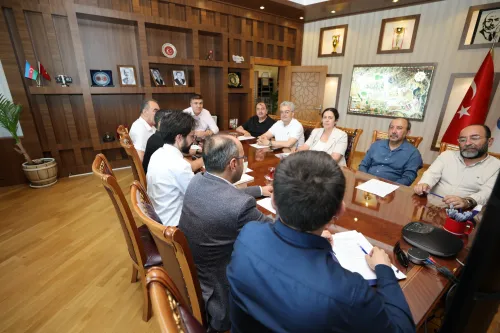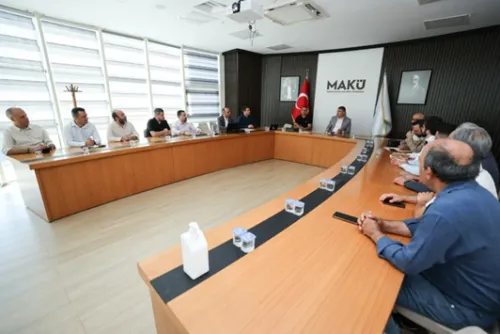

The Workshop on “The Roadmap for the Future in Vocational Schools” was held in Burdur
Yapılış Tarihi | 26 June 2025, Thursday

The Roadmap for the Future in Vocational Schools was Determined in Burdur
Burdur Mehmet Akif Ersoy University (MAKÜ) Vocational Schools Coordination organized the workshop themed “The Roadmap for the Future in Vocational Schools – Education, Technology, and Sector Meetings” at the Burdur Lavender Hill Hotel. The event, which brought together representatives from academia, industry, and the public sector at the same table, presented a strong vision for the future of vocational higher education.
Assoc. Prof. Dr. Ragıp Yıldırım: “This Meeting Offers a Common Mind for the Future”
In his opening speech, MAKÜ Vocational Schools Coordinator Assoc. Prof. Dr. Ragıp Yıldırım stated that the event was not just a meeting but also a strategic thinking process for the future. Yıldırım noted that there are approximately 80 associate degree programs in 13 thematic vocational schools within MAKÜ, emphasizing that preparations for the professions of the future are being made with programs focusing on areas such as digitalization, artificial intelligence, and green transformation.
Highlighting the importance of accreditation processes, industry collaborations, and applied education, Yıldırım said, “This workshop is a very valuable step to increase quality in higher education and prepare our students for a stronger future.”
Prof. Dr. Hüseyin Dalgar: “Education that Guides, Not Just Tells”
MAKÜ Rector Prof. Dr. Hüseyin Dalgar pointed out that the position of vocational schools within the university system needs to be reevaluated, stating, “In today's world where access to information has become easier, students are looking for not just knowledge but also inspiration and vision in the classroom.”
Dalgar noted that MAKÜ is one of the first universities in Turkey to implement the 7+1 education model, stating that this model allows students to take an active role in the industry for one year and that the employment rate has reached 65%.
He also emphasized that MAKÜ ranks 22nd in Turkey for graduate employment and 1st among universities established after 2006. Announcing that 3 to 5 micro-competency modules will be implemented in all departments starting from September, Dalgar stated that these modules will respond to the needs of the era, such as digital transformation, sustainability, and data literacy.
Strategic Evaluations from YÖK and MYK
YÖK President Advisor Assoc. Prof. Dr. İlyas Kara, who participated in the workshop, announced that more than 1 million 100 thousand students are studying in 1010 vocational schools across Turkey and that the occupancy rate has reached 100%. Kara shared the current situation and future predictions with his presentation titled “Analysis of the Current Situation of Vocational Schools and the Roadmap for Vocational Education.”
Özgen Uludağ, Head of the Vocational Qualifications Authority – Turkey Qualifications Framework (TYÇ), provided information about micro-qualifications, digital transformation, and developments based on artificial intelligence. He stated that there are currently 18 programs established under TYÇ at MAKÜ and that this number will increase rapidly. He also reminded that the Regulations and Principles Regarding Micro Qualifications have come into effect.
Discussion Topics Shaping the Future
Throughout the day, important topics such as;
- Relevance of curricula to sectoral needs,
- Internship and employment collaborations,
- Digitalization and technological transformation in education,
- Graduate tracking systems
were discussed. Participants included university administration, representatives from YÖK and MYK, industry representatives, academics, students, and graduates.
At the end of the event, the facsimile of the book “Safahat” was presented to the speakers by Rector Prof. Dr. Hüseyin Dalgar.
This workshop organized by the MAKÜ Vocational Schools Coordination reflects the strong educational vision spreading from Burdur to Turkey, shedding light on the transformation process of Vocational Schools.